News
Fall 2025 Newsletter
18 November 2025
Welcome to the Fall edition of Europa Ciceroniana’s Newsletter!
Every few months, our team will update you on the latest developments regarding our project. Of course, we will also look forward to upcoming events. Do you wish to receive these updates in your personal mailbox? Sign up using this form. Your address will not be shared or used for other purposes.
In this Newsletter
- Looking ahead to our next meeting: Ljubljana
- Looking back: the Turin meeting
- Archias… takes centre-stage
- From text to visualizing the clauses: presenting Cicero’s Pro Archia in a graphic novel format
- Archias… on the silver screen
- Archias… beyond the boundaries of space and time
- Update on the commentary website
 Looking ahead to our next meeting: Ljubljana
 The next international meeting of the Europa Ciceroniana group will be at the University of Ljubljana between 26 and
28 March 2026.
The theme of this meeting will be the reception of the
speech between antiquity and our own times. There will be
a few short lectures on the topic, with ample time to discuss
your thoughts in international groups in a workshop setting
and to talk about how we can best include reception within
the regular teaching of Latin texts at school.
The programme will soon be published on the project website. As an appetizer, you can already find three brief digital lectures about the reception of the speech on this webpage.
 Looking back: the Turin meeting
By Maurits Lesmeister
One can’t be too Italian when it comes to hospitality. The second international meeting of the Europa Ciceroniana project, held in Turin last September, was memorable for many reasons.
First, of course, there was the programme itself: in the spirit of the Paris meeting, there was an alternation of lectures (varying from the actual focus of these days, the actio, to a discussion on the meaning of citizenship in the ancient world) and the exchange of ideas (didactic as well as content-related) between teachers concerning education – both generally and on the Pro Archia. The first drafts of the website of our online commentary, also shown in the meetings, looked really promising and provoked praise and new food for thought. Perhaps the highlight of the program came early: the Thursday afternoon museum visit was absolutely thrilling. Turin hosts one of the most exiting Egyptian collections in the world, and our exceptional tour guide was the ideal person to make our company familiar with it. Apart from the program itself, the fact that so much attention had been paid to lunches and dinners made for a fruitful weekend, for nothing helps a conversation on Cicero like a rosso from Piedmont.
In short, this meeting was a worthy follow-up to the Paris edition: many thanks to our hosts, who devoted so much time and energy to it. In Turin, all participants also had the opportunity to showcase their approach to reading Pro Archia with their students. Below are four very creative highlights!
🎭 Archias… takes centre-stage
By Micol Jalla and Ermanno Malaspina
How can Cicero speak to young people today? Blending classical inspiration with contemporary sensibility, the theatre piece Somnium Emmae, created by Ermanno Malaspina (IT) and his students and directed by Micol Jalla (IT), is an answer to just that question. The play is a dreamlike reinterpretation of Archias’s existential experience between inclusion and exclusion, seen through the eyes of a modern-day high school student who hates both Latin and Cicero. Yet, like Archias, she searches for her true personal and cultural identity: in the end, she discovers not only herself but also the beauty of the Latin language.
The performance was created as part of a research project exploring how ancient literature can speak to contemporary teenagers through theatre. Presented in Italian during the Turin Europa Ciceroniana conference, the piece offered a 10-minute glimpse into a work-in-progress that will soon be entirely rewritten in Latin. The project will continue its journey in Portugal, with a submission to the Thalia Festival in Braga (August 2026), where the group will hopefully present a full-length version, connecting classical education with today’s questions of belonging, identity, language, and imagination.
💬 From text to visualizing the clauses: presenting Cicero’s Pro Archia in a graphic novel format
By Annegien Theunissen
If we want to come close to actually hearing Cicero deliver his court speech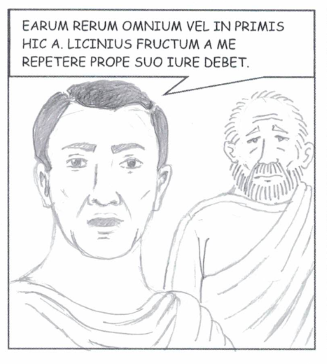 , we can either re-enact the speech with actors or visualize him doing so in a graphical style. I chose to explore the latter. My goal was to stimulate students to visualize the text and to facilitate its translation.
In order to help my students in these matters, I started producing an example of how we may visualize the text of the Pro Archia in the form of a graphic novel. The techniques of graphic novels (pictures and segmentation of the text in text balloons), provide an attractive and accessible version to read, especially because they stimulate the reader to imagine Cicero actually speaking to his audience, and because they enhance their insight into the structure of Cicero’s sentences. As for this last aspect, a graphic novel-type of presentation literally shows how the speech unfolded in time, sentence by sentence, clause by clause, instead of presenting the speech as a block of text. This can help students to understand the complexity of the Latin speech bit by bit without getting overwhelmed by the text as a whole.
We can thus accommodate an ancient Latin text to the taste of our audience and help our students to deal with the complexity of Cicero’s language.
📽️ Archias… on the silver screen
By Marie Cerati
"But, Madam, he's talking about us today!"
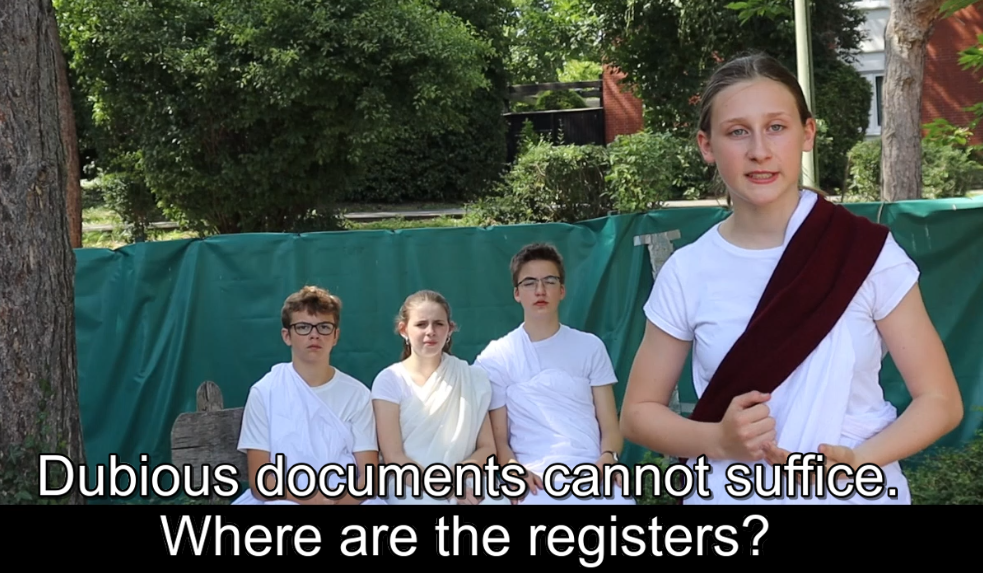 As a secondary school teacher in the European Schools system, Marie Cerati (FR) hesitated to get involved in the Pro Archia project with her group of seven 14-year-old pupils, who were certainly curious and passionate about antiquity, but whose language skills were too weak to read the entire text in Latin. She and her class therefore approached the speech as an investigation, using the text mostly, but not only, in translation: why was Archias accused of usurping Roman citizenship? Who was Gratius? What did Archias risk losing if Cicero's defence was not effective? As they progressed into the rhetorical structure of the speech, her pupils identified completely with the issues raised by Cicero: "But, Madam, he's talking about us today!" From that moment on, she had no longer to suggest anything, but simply followed their lead! Wanting to show their non-Latinist classmates how the study of Antiquity can help us better reflect on the issues of the contemporary world, they came up with the idea of a short film drawing parallels between ‘Rome, 62 BC’ and ‘Today’; they wrote their scripts, learned them and put them in action. One pupil filmed and edited the whole thing. It was a great collective adventure, and Marie was proud to showcase the result in Turin, which soon will be available on the website as well. Her students are not likely to forget Pro Archia anytime soon!
🔗 Archias… beyond the boundaries of space and time
By Tiziana Paracino and Rebecca Ferrassa Urani
A group of students from Novara, Italy, guide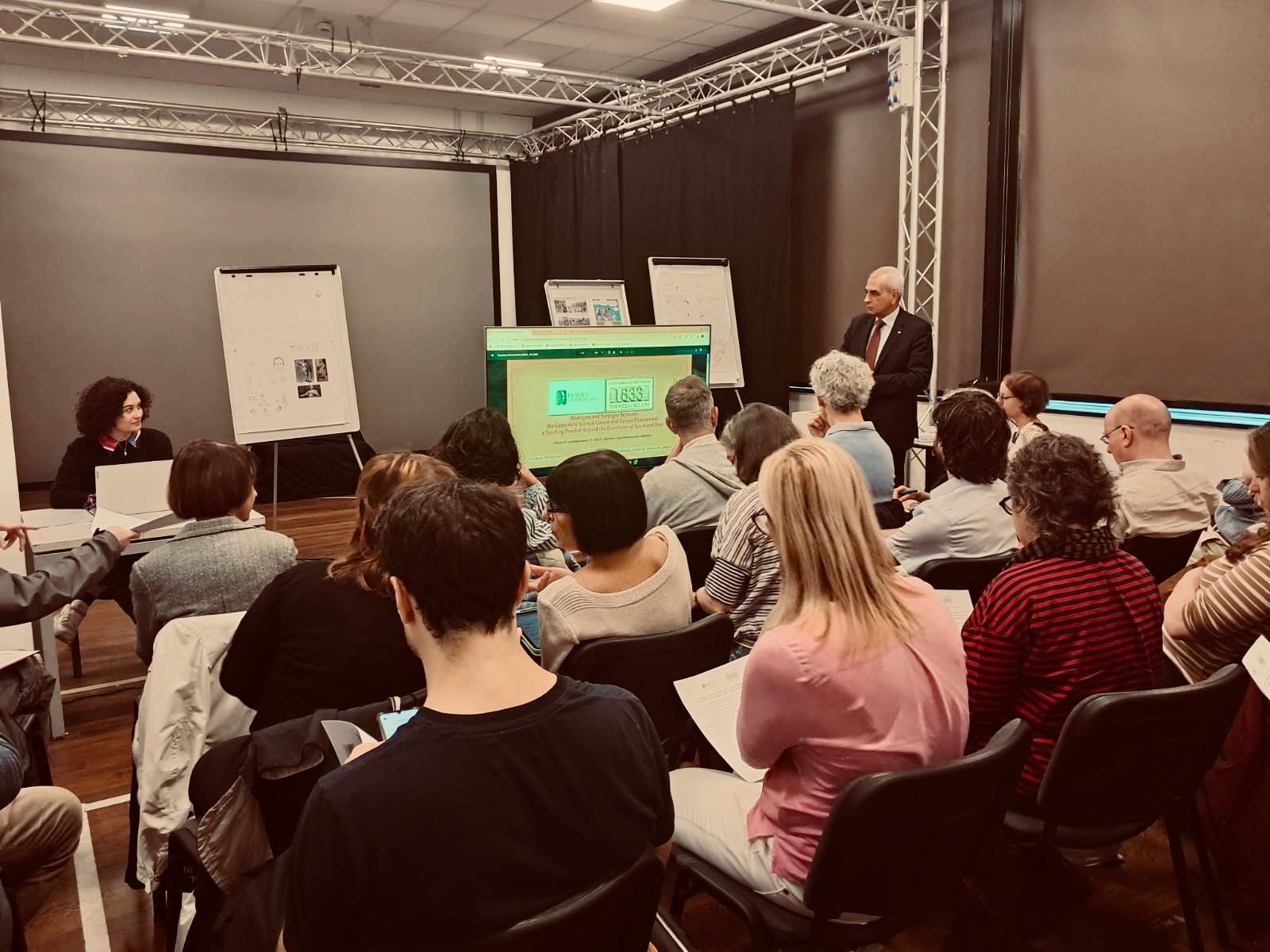 d by Tiziana Paracino (IT) and Rebecca Ferrassa Urani (IT), collaborated on the translation and rhetorical and linguistic analysis of paragraph 30 and the peroratio of Pro Archia. Through personal reflection and peer discussion, the students established interdisciplinary connections for the production of an original dossier. The students drew comparisons between the Latin speech and other literary, artistic, legal, and musical works, such as Institutio Oratoria, article 1 of
the Italian Penal Code and even Bob Marley’s
song Get Up, Stand Up.
The main objectives included developing independent translation skills and consolidating morpho-syntactic competence, while also focusing on historical contextualization and a socio-pragmatic interpretation of the text. Peer discussion and an active learning approach helped maintain high levels of motivation in the students, as well as enabling them to apply their knowledge and to feel genuinely involved. In the end, the project contributed to students’ recognition of the value of Roman classical heritage in shaping European tradition.
According to the teachers themselves, the group’s self-assessment skills, their desire for self-improvement and a great team spirit formed the keys to this experience. More information on Tiziana and Rebecca’s work in this project can be found the journal ClassicoContemporaneo, 11 (2025).
🤖 Update on the commentary website
Can we manage to make all students of Latin in our countries profit from our international collaboration? Can we make an engaging and useful online school commentary on the Pro Archia in five languages for students in Italy, France, the Netherlands, Slovenia and Germany? And will we be able to help teachers develop innovative didactic ideas? We hope to answer all these questions with “yes”, as we are currently working on exactly such an online commentary. It is the product of our international meetings, but at the same time, each country will work on a commentary that fits into its national didactic tradition. In our last newsletter, we already gave a sneak peek of the format.
What kind of content can you expect?
- The Latin text itself, of course, with a button to have it read aloud in each language.
- Notes on relevant linguistic, rhetorical and historical aspects of each paragraph, plus a translation.
- Additional information on topics like Roman citizenship, the juridical system, Cicero’s publication of his speeches, the reception of this speech, all with their own dedicated page.
We hope to help many new readers of this famous speech to understand it better, and maybe even to become inspired by it! We are looking forward to giving you the next update about the project soon.